
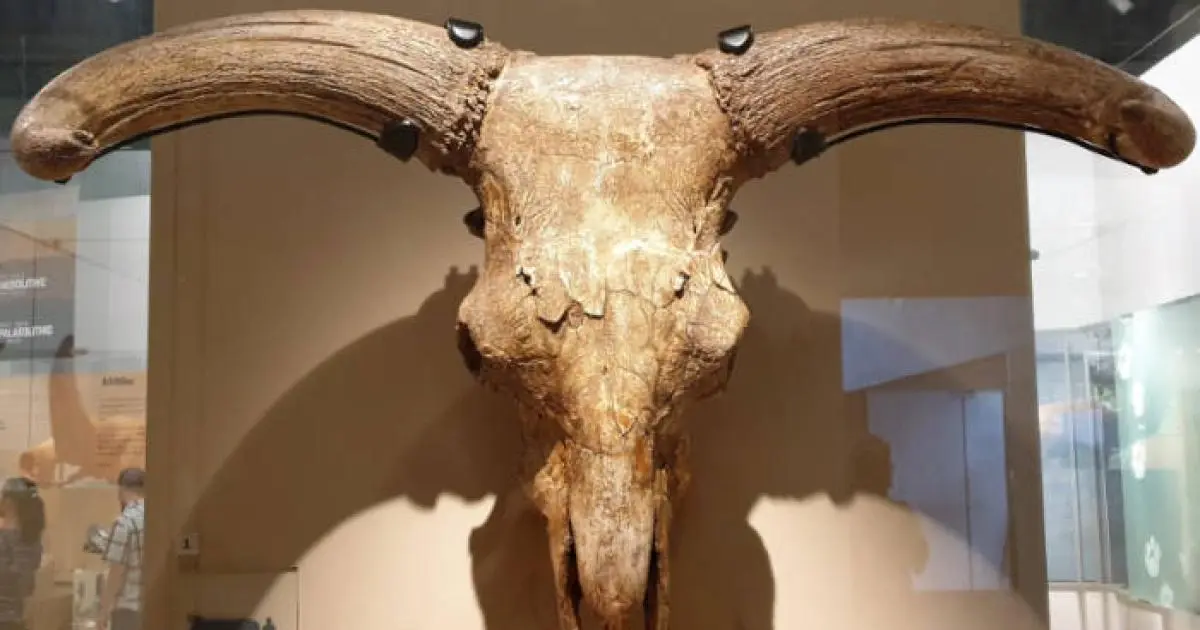
 Researchers have repeatedly attempted to unravel the mystery of 35 horned skulls found in the cave in central Spain. These fossilized remains, left behind by Neanderthals, belong to aurochs, deer, and steppe rhinoceroses. The reason why the ancient inhabitants of the cave preserved these animal skulls remains a mystery to science.
Authors of a new study from Spain, Portugal, and China believe that Neanderthals collected the skulls in the cave for ritualistic purposes. The team suggested that this tradition was passed down from generation to generation over a long period.
What Did the Scientists Discover?
Evidence in the Cueva Des Cuvierta cave indicates that made fires there. However, any other animal remains are absent. It is likely that only the heads were brought into the cave.
Researchers had previously dismissed the theory that these skulls were from mammals consumed by ancient relatives of modern humans, as there is little meat in an animal’s head.
Data collected by the team and its predecessors suggest a certain symbolic function for the horned skulls. Scientists are increasingly leaning towards the idea that these findings had a ritualistic purpose. Interestingly, in previous years, this notion was considered bold and dubious.
The thing is, many researchers view the spiritual world and cognitive abilities of Neanderthals as quite primitive. However, the unique collection of horned skulls indicates that Neanderthals were capable of abstract thinking and ritualistic behavior.
Moreover, the fact that the skulls are scattered across several meters of sedimentary layers may suggest that they were likely placed in the Cueva Des Cuvierta cave not all at once. This also implies that Neanderthals collected the skulls over an extended period, as reported by IFLScience.

Unfortunately, the team has not yet established the exact period during which the bone remains accumulated in the cave. However, this could have occurred approximately 50,000 to 40,000 years ago.
Researchers also conducted a detailed geostatistical and spatial analysis of this layer of sediment and the unusual artifacts contained within it. The results showed that the sediments accumulated as a result of successive rockfalls. The layers with a lower concentration of boulders indicate periods of relative calm between avalanches. The fact that animal remains are interspersed with these intervals proves that the skulls accumulated here over an unusually long time.
“The repeated use of a limited space suggests that the appearance of the skulls was part of a recurring, culturally conditioned behavior (a transmitted practice) that lasted over an indefinite but extended period,” the authors of the study wrote. It is now clear that the collection of skulls was added to by various generations of Neanderthals.
“The integration of geological, spatial, and taphonomic data showed that the accumulation of skulls from large herbivores was not a one-time event but likely the result of repeated episodes of a long-term process,” the researchers noted. This process is not related to providing food for Neanderthals.
The results of the study were published in the journal Archaeological and Anthropological Sciences.
