
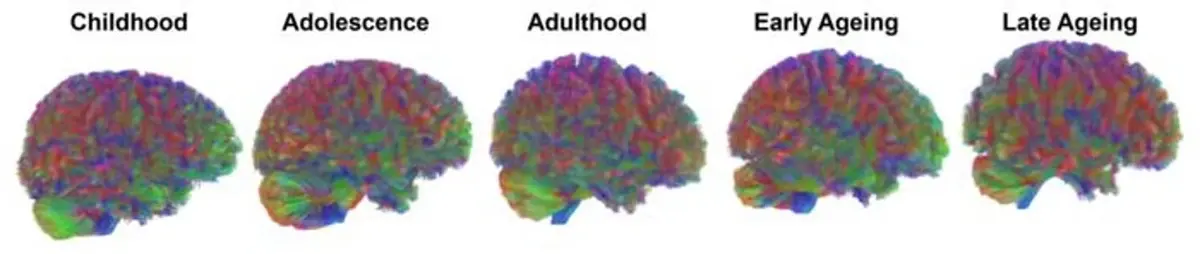
 According to new research, across an average human lifespan the brain goes through five distinct stages of development.
To uncover them, neuroscientists from the University of Cambridge scanned the brains of around 4,000 people from birth to 90 years old. Ultimately, the researchers identified key milestones that mark fundamental changes in the neural connections that let the brain function.
One surprising finding is that adolescence begins around age 9 and lasts until about 32.
The study, published in the journal Nature Communications, confirmed that our brains are constantly learning and adapting as we absorb new information. But this process is not smooth or continuous; it comes in bursts of activity, especially in the first half of life.
Five Key “Epochs” of Brain Development
Childhood – from birth to 9 years.
Adolescence – from 9 to 32 years.
Adulthood – from 32 to 66 years.
Early Aging – from 66 to 83 years.
Late Aging – from 83 years onward.
These distinct “epochs” were identified using datasets obtained from diffusion MRI scans, which allowed researchers to map neural connections by tracking the movement of water molecules through brain tissue.
Dr. Alexa Mousley, who led the research, noted, “We knew that the structure of the brain is crucial for our development, but we lacked a comprehensive picture of how it changes throughout our lives and why.”
Understanding these “epochs” provides context for recognizing when our brains may be most effective or vulnerable at different life stages. It helps explain why people’s brains can develop differently at critical moments.
Childhood
The team discovered that during the first “epoch” (from birth to 9 years), the brain undergoes “network consolidation.” In this process, the child’s brain trims the excess synapses it produced, leaving only the most active connections.
By the end of this stage, cognitive abilities change significantly and vulnerability increases. After this stage, the risk of mental disorders rises, as reported by The Independent.
Adolescence
During adolescence, the brain’s communication networks become increasingly sophisticated. This “epoch” is characterized by faster, smoother communication both within specific brain regions and across the whole brain. That transformation leads to a significant improvement in cognitive skills.
The team said this process typically finishes only after the age of 32.
Adulthood
Starting around age 32, the longest “epoch” begins—adulthood. The architecture of the brain stabilizes compared with earlier phases. Over the next 30 years, there are few major turning points.
Despite this stability, the researchers found that some brain regions gradually become more disconnected during this period.

Early Aging
The reorganization of the brain’s neural networks peaks between the ages of 60 and 70. Dr. Mousley said this is likely “related to aging, during which the number of neural connections increasingly declines as white matter begins to degenerate.”
This is a period when people face an elevated risk of serious neurological diseases that affect the brain.
Late Aging
The final stage of brain-structure change occurs around age 83. The researchers believe a defining feature of this “epoch” is a marked weakening of regional connections in the brain. People increasingly rely on well-worn neural pathways and areas.
Duncan Astle, a professor of neuroinformatics at Cambridge, said the research helps us understand how vulnerable the brain is at different stages and points to ways to treat specific conditions.
“Looking back, many of us feel that our lives have consisted of different stages. It turns out that the brain goes through them as well,” he said.
Photo: Unsplash