
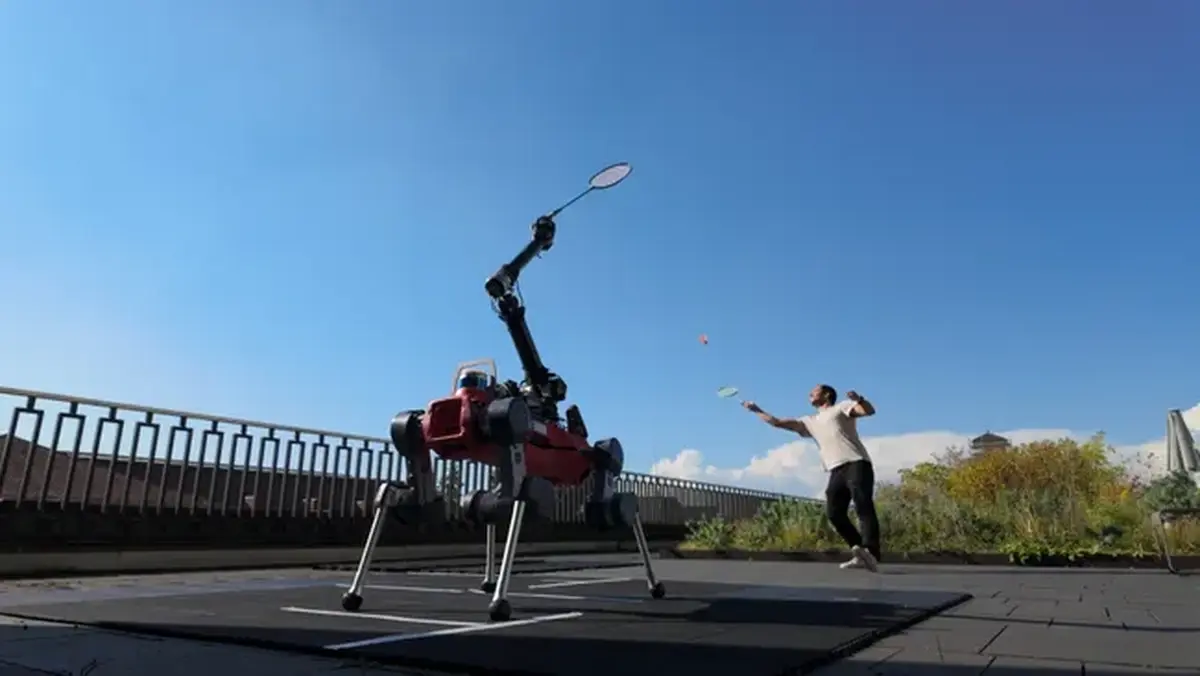
 Researchers at the Swiss Federal Institute of Technology Zurich have taught a robot dog named ANYmal to swiftly navigate a badminton court, track the shuttlecock’s movement, reach for it with a racket, and successfully hit it over the net.
This breakthrough demonstrates that four-legged robots equipped with manipulators can compete in complex, dynamic sports scenarios.
How the Robot Dog Became a Badminton Player
The dog-like robot ANYmal, weighing 110 pounds and standing half a meter tall, confidently maneuvers through challenging terrain on its four legs, overcoming obstacles with ease.
Previously, researchers had trained such robots to fetch objects and open doors. However, coordinating limb movement and visual perception in a dynamic environment remained a significant challenge in robotics.
“Sports provide a great domain for this kind of research because you can gradually increase the competitiveness or complexity,” said lead author Yuntao Ma in an interview with Live Science.
His team equipped the robot dog with an attached arm that holds a badminton racket at a 45-degree angle. With the attached arm, the robot’s height increased to 5.2 feet.
Overall, the robot had 18 joints in its limbs. Scientists developed a complex embedded system to control the leg movements. The team also added a stereo camera with two lenses to help the robot process visual information about the approaching shuttlecock and determine its trajectory.
The robot then learned to play badminton through reinforcement learning. Using this type of machine learning, it explored its environment and, through trial and error, learned to detect and track the shuttlecock, move toward it, and swing the racket.
Researchers created a simulation of a badminton court, with a virtual robot at the center. Virtual shuttlecocks were served from the opponent’s side of the court, and the robot had to track and assess their flight trajectory.
Training Stages
Next, researchers developed a rigorous training program to teach the robot dog to return the shuttlecocks. A virtual coach “rewarded” ANYmal for the correct racket angle, swing speed, shot accuracy, and effective movement across the court.
After 50 million attempts, researchers created a neural network capable of controlling the movement of all 18 joints in response to the shuttlecock.
A Step Toward Real Play
Following the simulations, scientists tested ANYmal in real-world conditions. It tracked a bright orange shuttlecock served by another machine while researchers monitored the speed, angles, and landing points of the shuttlecock.
The robot dog had to quickly cross the court to hit the shuttlecock hard enough to send it over the net and into the center.
After intensive training, the robot could track shuttlecocks and accurately return them at speeds of about 39 feet per second—nearly half the swing speed of an average amateur. ANYmal also adjusted its movement trajectory based on its distance from the shuttlecock.
Yuntao Ma was impressed by how coordinated the robot dog was in moving all 18 joints. That’s particularly challenging because each joint learns independently, yet executing a movement requires them to act in sync.
The team also noted that ANYmal returned to the center of the court after each shot, just like human players do.
However, the robot dog did not account for the opponent’s movements. Researchers plan to teach ANYmal to anticipate an opponent in the next phase.
Ma says the research could have applications beyond sports, such as clearing debris during disaster recovery. ANYmal effectively combines visual perception with dynamic movement.
The results of the study were published in the journal Science Robotics.