
From time to time, well-known plants suddenly surge in popularity—thanks to breeders’ tireless work, they gain new useful traits.
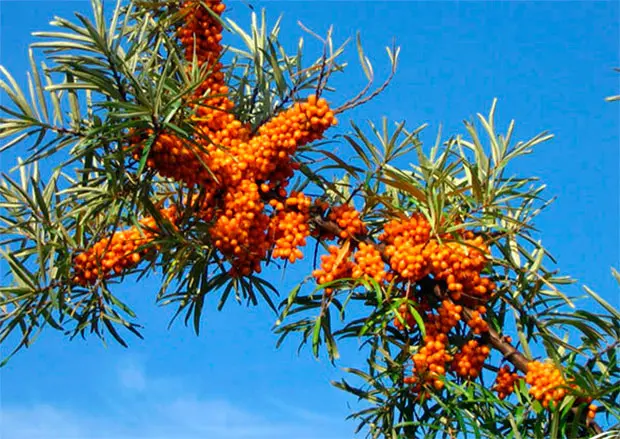
Sea buckthorn is a striking example. More than a century ago it was noted as a plant that deserved much wider use. Yet it still hasn’t become as widespread as it should be.
The berries of sea buckthorn are rich in vitamin C and other nutrients. Just 100 grams of the berries, similar to black currants, provide one to two daily doses of vitamin C. They also contain more vitamin E than any other fruit or berry, second only to wild cloudberries. The pulp contains about nine percent oil, which is used to make highly effective treatments for burns, frostbite, eczema, anemia, stomach ulcers, and other ailments.
People make concentrated vitamin juices, jams, jellies, and other valuable food products from the berries. Sea buckthorn oil and juice are widely used in cosmetics. Healing compounds have also been found in the plant’s bark.
Sea buckthorn is used as a vitamin supplement for livestock. It also serves as an attractive ornamental plant.
In the wild, sea buckthorn grows across much of the former USSR—from the Baltic to the Black Sea. It also grows in the Caucasus and southern Siberia. The plant thrives mainly along the shores of seas and lakes, in river floodplains, and on sandy soils, particularly riverbanks. It’s used to stabilize shorelines, road embankments, and canals, and to form protective strips against snowdrifts.
In recent years, breeders have selected the most promising varieties—’Novinka Altaya,’ ‘Vitamin,’ ‘Maslyanaya,’ ‘Golden Ear,’ and others. These varieties produce large fruits that detach easily from the thornless branches.
Like black chokeberry, the new varieties come from Altai, primarily from the M.P. Lisavenko Research Institute of Horticulture in Siberia, which holds the Order of the Red Banner of Labor. The cultivated sea buckthorn is propagated only vegetatively.
The most reliable time for transplanting is early spring. In gardens, sea buckthorn grows and bears fruit best in loose, humus-rich soils. It also demands consistent moisture.