
Children do better in math when lessons include music. Researchers reached that conclusion after analyzing nearly 50 years of studies on the link between the two disciplines.
Pythagoras Already Connected Music and Mathematics
The construction of musical instruments is based on mathematical principles established by Pythagoras. The ancient Greek mathematician is known not only for his theorem about right triangles but also as one of the first music theorists.
Pythagoras laid the mathematical foundation for the modern Western octave and for musical intervals. He and his followers, the Pythagoreans, saw mathematics as a science that reveals the universe’s beauty, and they regarded music as part of that order.
According to tradition, Pythagoras first became interested in the relationship between mathematics and music when he heard different notes produced by hammer strikes on an anvil in a blacksmith’s workshop. To reproduce and study the sounds, Pythagoras used the lyre and the monochord—a musical instrument he developed.
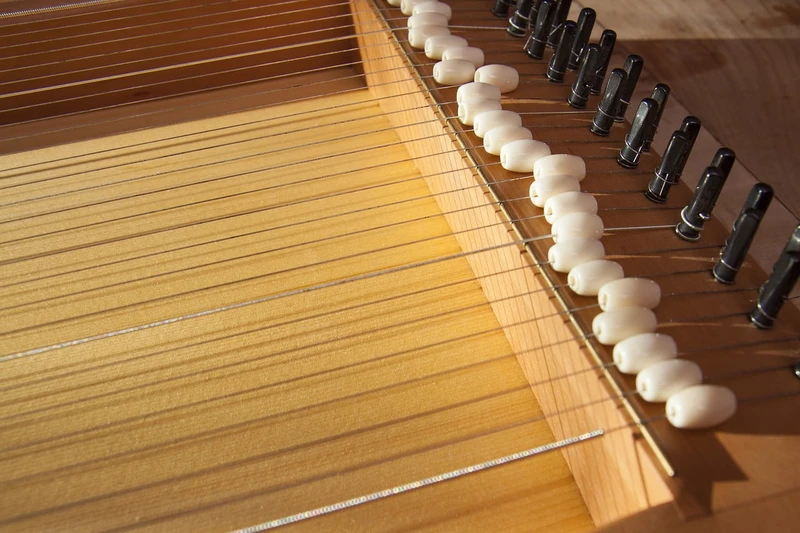
Monochord
He found that pressing the lyre string at its midpoint produces a pitch with a frequency ratio of 1:2, which we hear as an octave.
You can demonstrate this principle with a simple bottle experiment. Blowing across the neck of a bottle produces a sound similar to a flute. Fill the bottle halfway with water and blow again to hear the same note an octave higher. Adding different amounts of water changes the air-to-liquid ratio and creates different pitches.
As Skyhooks guitarist Red Symons notes, chords on a guitar are “just mathematical arrays.” Based on that idea, teachers can integrate music into math lessons by having students clap different rhythms while learning counting and fractions.
Researchers say such musical exercises reduce math anxiety and make classes more enjoyable. According to Cosmosmagazine, a recent meta-analysis found that children who use music to learn math are more motivated and place a higher value on arithmetic.
The Influence of Music on Learning Mathematics
Previous studies showed a link between students with a good foundation in music and higher achievement in mathematics. But the benefits of using musical activities directly in math instruction were less clear.
Dr. Aicha Akin from Turkey analyzed 55 studies published between 1975 and 2022. Nearly 78,000 students participated, ranging from preschool to university age. Students with musical education took math tests, and their results were compared to those of students without music education.
The meta-analysis included three types of musical intervention: regular music lessons with singing and clapping, learning to play musical instruments, and music lessons integrated into math. In all three cases, students who received musical instruction performed better in math.

The best results were observed among those who participated in integrated music-math lessons.
Among students in the integrated music-and-math lessons, 73% scored significantly better than students without music lessons. Additionally, 69% of students who learned to play instruments and 58% who took regular music lessons improved their math performance compared to students without musical intervention.
The relatively small number of studies on some outcomes made it impossible for the meta-analysis to examine other factors, such as socioeconomic status and the total duration of musical activities. Still, the study highlights the potential of integrated music education to boost children’s math learning. Dr. Akin suggests that having math and music teachers plan lessons together may help reduce students’ anxiety about math tasks and improve achievement.
