
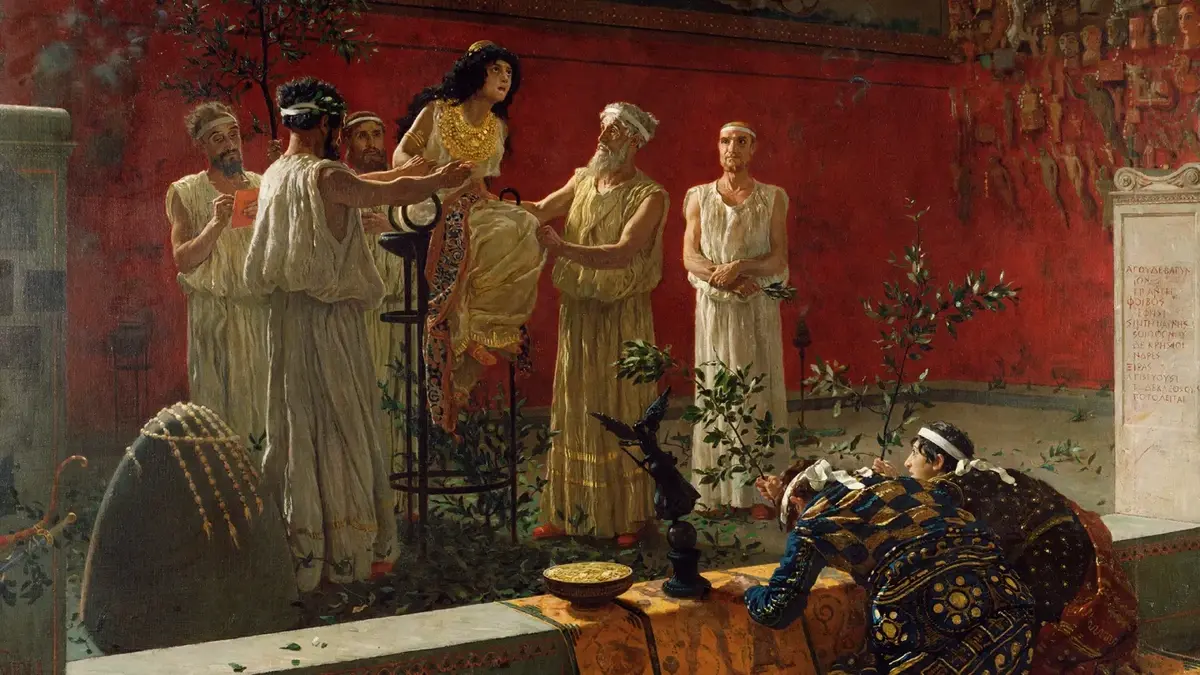
For centuries people traveled to Delphi in southern Greece hoping to catch a glimpse of their future. There, inside the Temple of Apollo, the chosen priestess known as the Pythia would fall into a trance and deliver in what was believed to be Apollo’s own voice. Ordinary citizens, the wealthy, and even Alexander the Great made long journeys to hear the priestess’s counsel on important matters.
People didn’t think the Pythia had supernatural powers. Ancient writers like Plutarch, who served as a priest at Delphi in the first and second centuries, described her instead as “a vessel for a force that comes from the Earth.”
Plutarch wrote that the temple at Delphi was built over a natural spring where water and cracks in the rock produced a fragrant gas the ancients called pneuma. On certain days a few times a year the chosen priestess would sit on a tripod over a fissure and inhale enough of that gas to enter a trance. The experience was brutal: the oracle might scream, thrash in hysteria, or faint.
At the temple’s height several women shared the oracle’s duties because entering the trance state was so physically demanding. Serving as the Pythia was seen as both a great honor and a heavy burden.
Plutarch said that in his time there was less pneuma than before, and that decline helped reduce the temple’s popularity. After the temple closed in 393 CE, the pneuma remained an unsolved scientific mystery. Did that gas really induce trances? And if so, where did it come from?
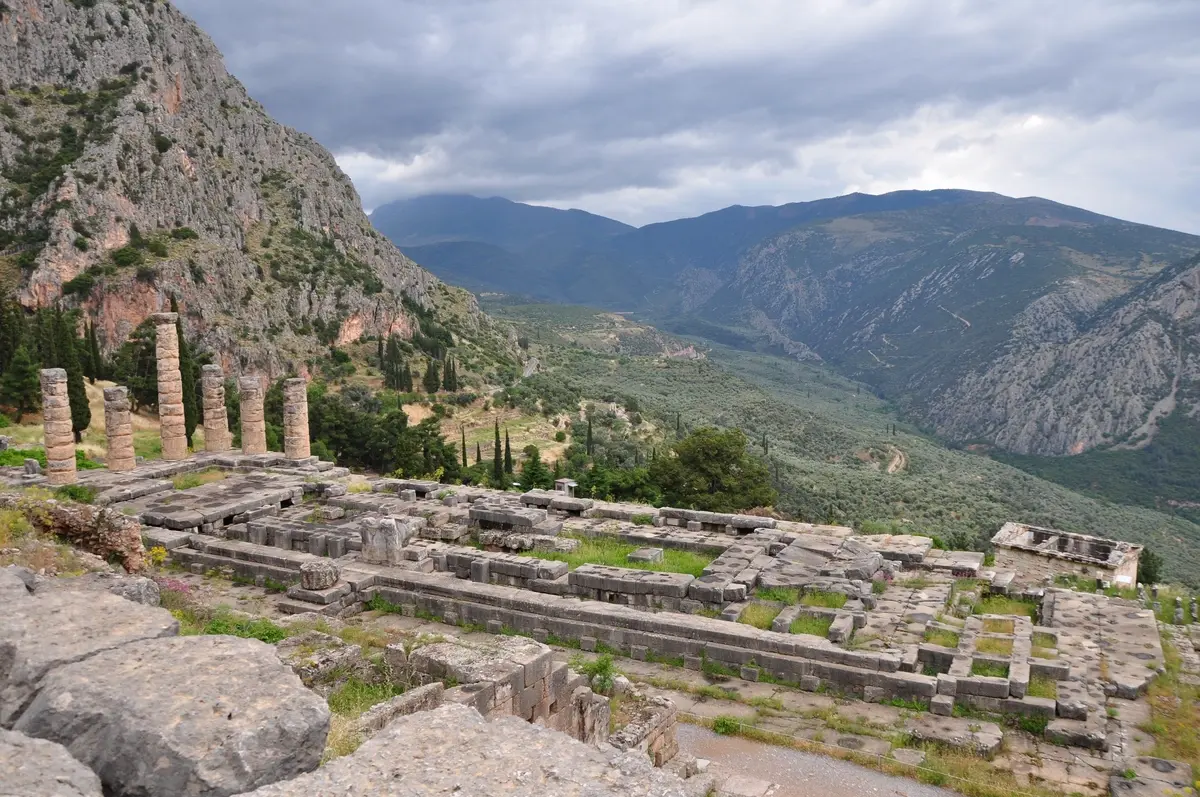
Temple of Apollo at Delphi
How researchers followed the clues
Excavations at Delphi between 1892 and the 1950s failed to reveal a single large crack in the rock that could have been the source of the gas. Early investigators assumed gases only rose from underground near volcanoes, and Delphi has no volcanoes. That assumption led many scientists to dismiss the ancient accounts as legend. Later work, prompted by those old texts, reached a very different conclusion.
“When I have written sources from the ancient world, the first thing I try to figure out is what I can learn from them,” archaeologist John Hale told Popular Science. In the 1990s Hale and an interdisciplinary team finally found scientific evidence that matched the ancient descriptions of the temple at Delphi.
Gas seeping up from shifting tectonic plates
During geodetic surveys Hale’s colleague, Dutch-American geologist Jelle Zeilinga de Boer, noticed a fault running under the temple at Delphi where two tectonic plates met. The movement of those plates can produce earthquakes and other geological activity, including the release of gases.
De Boer wondered whether the ancient pneuma at Delphi could have been a light hydrocarbon gas seeping up out of the limestone beneath the temple.
When two tectonic plates grind against each other along a fault line, the friction can generate enough heat to convert solid hydrocarbons in the crust into gas. If the rock above contains enough openings or channels, that gas can travel to the surface—exactly the kind of behavior ancient writers described at Delphi.

Testing the rock for the oracle’s fumes
Early digs at Delphi uncovered a porous limestone layer deep under the temple. That layer could have provided invisible channels for gas to flow up to the surface—and into the lungs of the waiting priestess.
But archaeologists found no obvious hydrocarbon deposits at the site. Scientists then decided to test the limestone itself to see whether it contained those compounds. Finding hydrocarbons in the rock would solve a key missing piece.
In 1996, after getting permission from the Greek government, John Hale and Jelle Zeilinga de Boer made their first expedition back to Delphi. They collected bedrock samples and sent them to a lab for analysis. As they suspected, the porous limestone proved rich in hydrocarbons such as ethane, methane, and ethylene.
So what exactly did the oracle inhale?
Ethylene is a hydrocarbon and one of the world’s most widely used organic compounds. In the past ethylene was even used as a surgical anesthetic because inhaling it at concentrations around 20 percent can cause loss of consciousness.
What happens at lower, still relatively high concentrations? Toxicologist Henry Spiller found many parallels between the altered states produced by inhaling ethylene and the ancient descriptions of the Pythia’s trance. People exposed to ethylene often remain conscious but behave oddly: they may become agitated, shout, convulse, and later have no memory of the episode after the gas dissipates. Hale called ethylene the “ideal analogue” for the ancient pneuma. Ethylene also has a sweet smell, which matches Plutarch’s description.
Repeated exposure to gases like ethylene carries serious health risks. Plutarch wrote that breathing this gas shortened the lives of the priestesses.
“Ethylene is one of those gases that are lighter than air; if it’s released, it travels upward through openings similar to those in the porous limestone at Delphi,” Hale explained. “After that, anyone standing above the openings can inhale the gas.”
Early excavations looked for one large chasm in the rock. Newer evidence shows that the gas probably seeped through many small openings, following channels carved by groundwater.
Archaeologists now conclude that the Pythia inhaled gas that rose through invisible channels in the porous limestone beneath the Temple of Apollo.
As Hale pointed out, Delphi was not the only temple with an oracle who predicted the future, but it is the only site where a fragrant gas became part of the historical ritual record.