
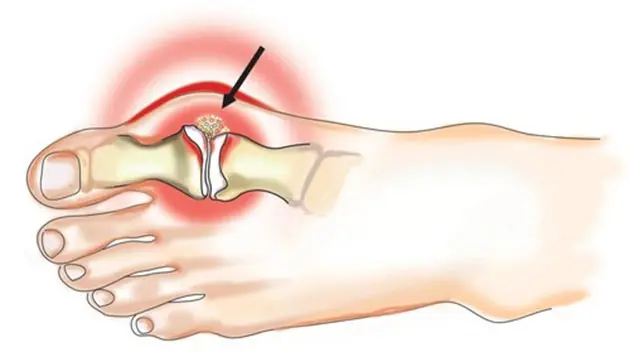
People often call this condition “salt deposition.” In reality, gout is a disorder of protein metabolism that causes uric acid and its salts to build up in bodily fluids, blood, and lymph. When the kidneys don’t filter properly, these substances settle in joints and tendons.
Thus gout begins. The disease usually develops gradually, first affecting the smaller joints and eventually causing deformities.
The joints of the hands and feet take the worst of it. The joints hurt during movement and when pressure is applied, they swell, and their mobility decreases, which can lead to the formation of nodules known as “tophi.” Sometimes gout appears suddenly as sharp pain in a single, usually small, joint. A characteristic symptom is joint pain at dawn—around 4–5 a.m.—and sometimes before it rains.
Preventing and treating gout starts with a strict diet. Limit meat and fish, and when you do eat them, choose boiled over fried. Avoid plant-based foods that are high in protein—peas, beans, lentils, and mushrooms.
Common medications include atofan, urotropin, and urodan. Drink alkaline mineral water such as “Borjomi,” which many find helpful.
While these measures can reduce further salt buildup in the joints, they won’t remove salts already deposited there. Without removing those deposits, a patient’s condition is unlikely to improve dramatically.
Herbal remedies are often more effective for addressing existing deposits. Leading the list are hemp and pumpkin “milks.” Hemp seeds are nutrient-dense: they contain several essential amino acids, carbohydrates, alkaloids, and more. Prepare hemp “milk” this way: grind about 20 grams of hemp seeds in a mortar, add a little boiled water, and work until the mixture reaches a milk-like consistency. Bring the liquid to a gentle boil over low heat and sip it twice a day—half a glass in the morning on an empty stomach and the other half in the evening, about an hour to an hour and a half after dinner. Prepare fresh “milk” daily, and use untreated seeds. During the treatment, take baths, since baths are believed to help expel salts through the skin. Run the treatment for 10 to 15 days while sticking strictly to the diet.
Pumpkin “milk” is an alternative, though its preparation differs slightly. Shell about 20 grams of pumpkin seeds and soak them in 200 grams of warm water overnight. In the morning, pass the swollen seeds through a meat grinder and mix the resulting mass with the soaking water until smooth. Do not boil this version. Drink it the same way as the hemp “milk,” and follow the same 10–15 day course. Be aware that pumpkin “milk” can cause stomach aches, especially if treatment begins during the new moon—this can indicate the presence of parasites that are being affected by the treatment. Do not stop the treatment because of this reaction.
Some patients alternate between hemp and pumpkin courses, and there are cases where that approach produced the best results. The choice is up to the patient, remembering that treating gout is a long process that requires persistence, consistency, and patience.
Avoid alcoholic beverages, spices, and spicy dishes completely during treatment!
Now for local treatments. When salts accumulate in the cervical vertebrae, local therapy is unlikely to help. But when tophi appear on the hands, feet, and similar areas, the pain comes not only from the deposits but also from impaired nutrition of the skin’s nerve endings and reduced blood flow in the capillaries. For nodules, use poultices and compresses. In spring, harvest young nettle, soak it in a little water, mash it, and place these “dumplings” on the affected area overnight. Secure the herbal “dumpling” with adhesive tape. In other cases, make a poultice from knotgrass or young clover; different remedies work for different people because each patient may be missing different vitamins and trace elements.
About compresses made from your own urine: this is an old folk method. Soak a cloth napkin in urine, place it on the affected joint, cover it with plastic wrap, and bandage tightly. Leave the compress on overnight. Urine typically contains fewer salts than the formed nodule, so the solution can draw salts out through the skin.
Among poultices, field chicory (sometimes called “Peter’s whip”) is especially effective. Chop the herb’s shoots finely, pour boiling water over them, and apply the warm, soaked mass to the joints before bandaging.
Patients often ask how long compresses can be used. This treatment is not strictly time-limited. Unfortunately, many patients stop using compresses as soon as the pain eases and the nodules “shrink,” which usually means a significant amount of salt has already been drawn out.
Finally, remember: no matter how effective herbal treatments may seem, do not abandon medications like atofan and others. While herbal methods may remove deposits, the underlying disorder of protein metabolism still needs medical management.