
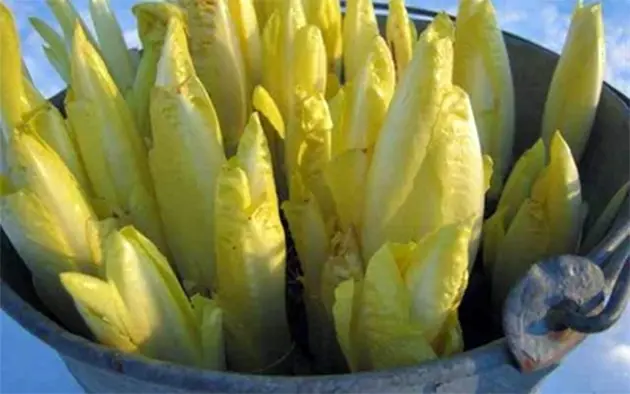
First, pick vegetables that force well indoors: onions, witloof chicory, parsley, and celery. Plant the bulbs and roots of these crops in a soil mixture in boxes. Sow salad greens and dill in the same way, and put cucumbers and tomatoes into separate containers like pots or buckets. For a winter garden, choose the brightest spot — an east- or south-facing window. Parsley, onions, and celery tolerate some shade, so a west-facing window will work for those crops. For forcing witloof heads, however, no light is necessary. Plant the root vegetables deeply in a box filled with sand. Place the box in a warm room and water it. To keep the witloof heads tender and flavorful, cover them with sand and keep them in the dark.
Prepare the soil mixture: mix 2 parts peat soil, 2 parts compost, and 1 part topsoil, adding 0.5 part wood shavings or river sand. If peat isn’t available, use 1 part topsoil, 1 part compost, and 0.2 part river sand. For every bucket of soil mixture, add 2/3 of a matchbox of potassium nitrate, 2 matchboxes of superphosphate, 1 matchbox of potassium chloride, 1 matchbox of potassium-magnesium fertilizer, and 1 matchbox of wood ash. Keep the soil evenly moist. Water with warm water once or twice a week.
Growing Greens. For cucumbers, use containers with a capacity of 7-12 liters. These can be large pots, plastic buckets, wooden barrels, etc. Not all varieties are suitable for growing indoors. The best options are long-fruited types that do not require pollination, such as “Moscow Greenhouse” and “Cucumbers.” If these varieties are unavailable, use other varieties but pollinate the flowers manually.
The soil mixture for cucumbers should consist of 5-6 parts non-acidic peat, 2-3 parts fertile soil, and 2-3 parts compost. For each bucket of this mixture, add 2 matchboxes of superphosphate, 2 matchboxes of potassium nitrate or urea, 1 matchbox of potassium sulfate, 1 matchbox of magnesium sulfate, and 2 matchboxes of wood ash. Mix everything well and fill the container. Sow germinated seeds to a depth of 1-1.5 centimeters. Put no more than 1-2 plants in each pot. To support vertical growth, create a trellis with wooden sticks or wire and attach it to the container.
As the plants grow, tie the stems to the support. Remove the lower five buds before the flowers open. The remaining buds will produce the main harvest. Pinch off the side shoots above the 2-3 leaves.
Start fertilizing a month after planting. For each bucket of water, dissolve 1 matchbox of urea, 1 matchbox of potassium sulfate, and 1/3 of a matchbox of magnesium sulfate. Before fertilizing, water the plants lightly, then apply the fertilizer solution at 1-2 liters per week until fruiting begins, and 3-4 liters per week during fruiting.
Apply a chicken manure infusion diluted 1:15 or 1:20 for good results. Alternate mineral fertilizers with organic ones. Water moderately, preferably with warm water (68–77°F), and only when the soil dries out — about twice a day. Follow this technique and you can harvest 8-10 kilograms of cucumbers (25-40 fruits) from a single plant.
You can also grow tomatoes on your windowsill. Keep in mind that tomatoes are sensitive to light and heat. Growing tomatoes in pots is especially rewarding because they can act like perennial plants and produce fruit for several years under favorable conditions.