

A sour face isn’t the only sign of a bad . A person’s walk also reveals a lot about their inner state. The movements of the arms and legs are especially telling while someone walks.
It turns out that changes in, and the coordination of, arm and leg movements are the cues other people use to judge your emotions.
A team from the International Research Institute of Advanced Telecommunications in Kyoto, Japan, asked volunteers to guess actors’ emotions from short video clips. While filming, the actors recalled events from their lives that had caused anger, joy, fear, or sadness, then walked a short distance in the dark while thinking about each memory. Tight-fitting clothing with reflective markers attached made the actors appear on screen as nothing but glowing moving dots. That setup kept observers from being distracted by facial expressions, so they judged only the gait.
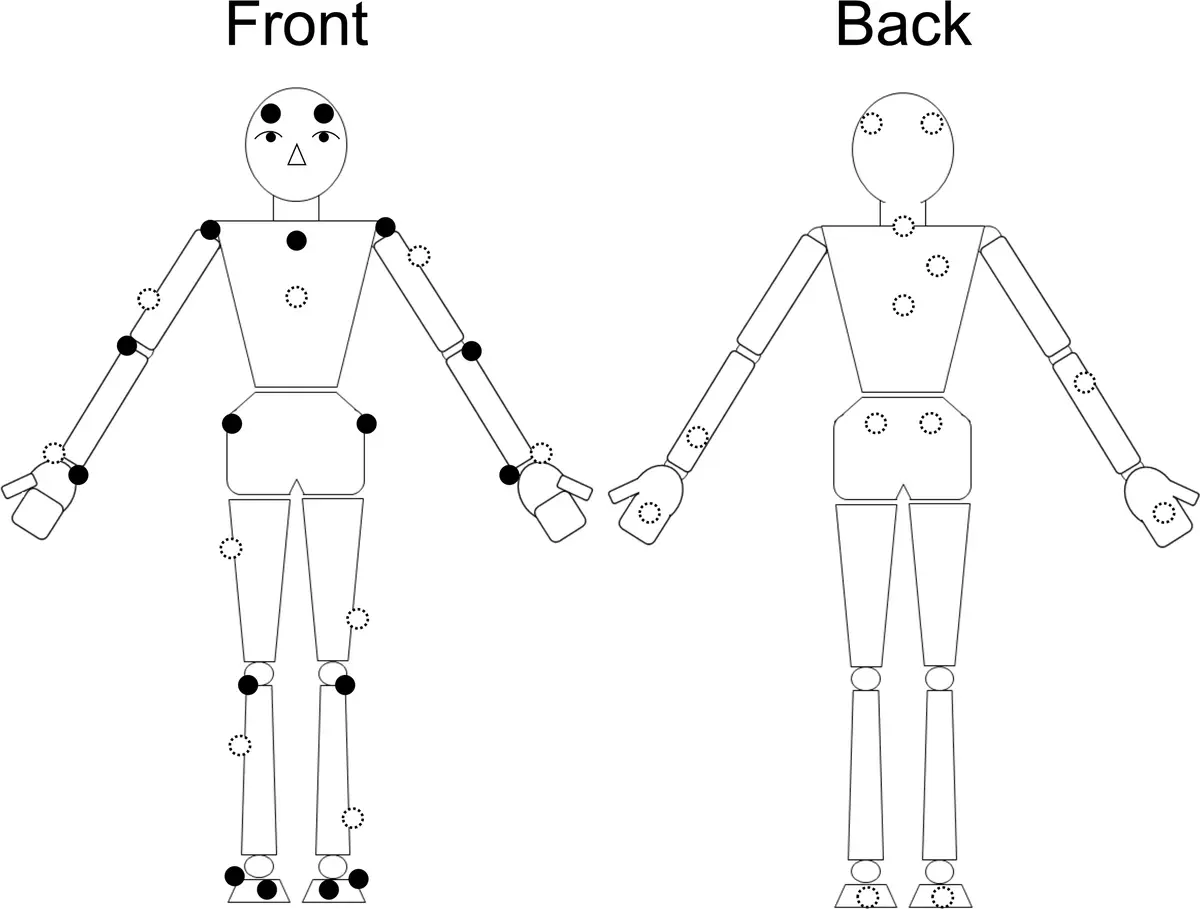
Diagram of reflective marker placement
After watching the videos, volunteers reported which each actor’s walk had prompted. They identified all the depicted emotions with better-than-chance accuracy, the paper in Royal Society Open Science reports.
In a second experiment, the team looked for the specific movements that reveal walkers’ emotions. The researchers filmed a neutral walk, then edited the footage to exaggerate or tone down the arm and leg swings. Observers read the more pronounced swinging as a sign of aggression, while the reduced swinging came across as sadness or fear.
The scientists welcomed the results because the study expanded the set of cues available for quickly evaluating people’s emotions and identified the specific movements that most clearly convey particular feelings.
“ is one of the most common and well-practiced full-body movements. So changes in emotional state can naturally show up in our walk. The results showed that movements with wider arm and leg swings were more often read as anger, while movements with shorter swings were more often read as sadness or fear,” said Mina Wakabayashi, the study’s lead author.
She says the ability to read emotions from body movement helps people understand others quickly during social interactions even without words. Spotting emotions from a distance lets you change your approach depending on whether someone appears angry or sad.
The work also has practical uses. By reading emotions from movement, law-enforcement officers could spot potential threats from certain individuals on surveillance video. In the near term, the findings could lead to devices that monitor people’s mental state while they walk.
Last month, researchers at the University of Texas at Dallas demonstrated a machine-learning algorithm that can identify anger, sadness, joy, and fear from a person’s gait, though with limited accuracy. Dr. Gu Eon Kan, a bioengineer and coauthor of that study, said one potential advantage is that it’s harder to fake someone’s gait than their speech or facial expressions.
Photo: Unsplash
Watch your gait: it treacherously reveals your state of mind.
4