
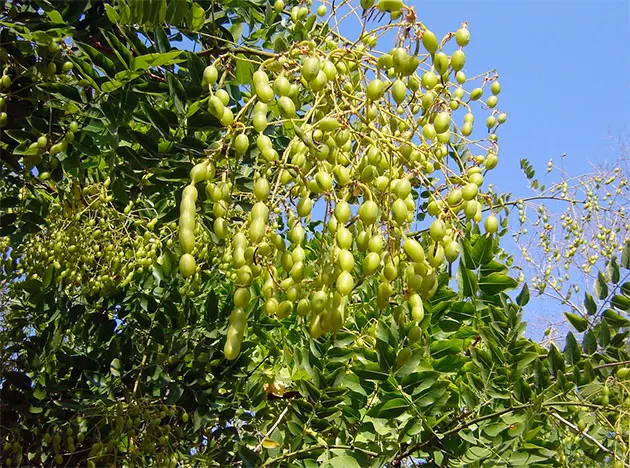
The Japanese sophora is a graceful tree in the legume family, native to China. It can reach up to 33 feet tall. Its leaves are compound and odd-pinnate. The small, yellowish-white flowers have a distinctive fragrance. The seeds grow in dark red pods that contain black seeds. That’s important because other legumes are sometimes sold as sophora at markets. In southern Ukraine, people cultivate the plant as an ornamental.
In conventional medicine, sophora tincture is used to treat various ulcers, including trophic ulcers, infected wounds, and burns. To prepare the tincture, soak 10 grams of crushed sophora beans (about a tablespoon) in 90 grams of vodka and keep the mixture in a warm place for 10 days, shaking it occasionally.
In folk medicine, people use the tincture for cracked nipples, boils, and phlegmon. Apply gauze soaked in the tincture under a compress and leave it on overnight. For hair loss, prepare a sophora tincture, wash the hair, then massage the tincture into the scalp until slight redness appears. Use this method in the fall and winter for best results, but to avoid drying the skin, do not use the tincture more than twice a week. Alternate the tincture with a decoction. Steep a teaspoon of crushed sophora in 95 grams of boiling water for 15 minutes, then strain it. Use a 5% dilution of the decoction for douching to treat female reproductive tract conditions.
To treat and help prevent internal bleeding—from the brain, heart, or retina—and to address hypertension, angina, and severe atherosclerosis, take the tincture internally: 10 drops to 1 teaspoon, 4–5 times a day. Take it for two weeks, then pause for two weeks.
Sophora has also shown effects in cases of typhus, high-acidity gastritis, ulcers, capillary fragility, liver diseases, and diarrhea. Much of the plant’s activity is attributed to its very high rutin content, which ranges from about 12% to 30%.
Instead of a bean-based tincture, use one made from the flower buds. To make it, soak 20 grams of buds in 100 grams of 70% alcohol and leave the mixture to steep for seven days. Take the unstrained tincture at a dose of 20–40 drops three times a day for a three-week cycle. Massage a 5% or 10% dilution of the bud tincture into the scalp to help prevent hair loss. Use the bud tincture for compresses to treat styes, for cupping therapy on eczema, and for hemorrhoids. Instill the diluted solution into the nose for colds, or insert tampons soaked in the tincture into the nasal cavity for sinusitis or frontal sinusitis. Use the tincture as a mouthwash for gingivitis, stomatitis, and to relieve toothache. Use sophora preparations together with vitamin C.
In Bulgaria, people use a powder made from dried buds for the same purposes; dose 0.2–0.5 grams, taken 3–4 times a day. Although no complications have been widely reported with sophora tincture, people over 65 should use caution with alcohol-based preparations. Prefer decoctions and powders for older adults.
Users can develop tolerance to sophora preparations, which reduces their effectiveness. Alternate sophora with other medicinal plants. It works alongside some homeopathic treatments, and preparations containing iodine, gold, or potassium can enhance its effects. Sophora may also help eliminate arsenic and salicylates in cases of poisoning.