
A few years ago, a mysterious incident occurred in Rome.
On a hot day, a car pulled up to a gas station. The passengers stepped out to stretch while the attendant prepared to fill the tank. Suddenly a high, piercing whistle cut through the air. Instinctively, people looked up at the sky, both alarmed and confused.
Before anyone could understand what was happening, a chunk of ice weighing about 110 pounds crashed into a tree, sending shards flying in every direction.
Once the initial shock passed, witnesses began to talk about the bizarre event. Some suggested a nuclear explosion; others thought it was just an enormous hailstone.
In fact, it was a piece of ice that had broken off an airplane approaching Rome. The aircraft had been cruising at high altitude and had accumulated ice. As it descended into warmer air, the ice softened, and a gust of wind dislodged a chunk that fell onto the gas station, narrowly missing the attendant.
In Wisconsin, a boy named Roger Jeyra had his own strange encounter. One day, while walking across his lawn, a piece of ice fell from the sky, shattered on impact, and split into two pieces.
Roger was astonished—how could ice fall in August? He grabbed a container and collected the fragments, but by the time he got home they had melted. He poured the water into a bottle, sealed it, and sent it with a letter to Professor John Budhue in California.
The scientist was intrigued by the unusual package. His first thought was that the ice had broken off an airplane. But no planes had flown over that area of Wisconsin that day.
Maybe it was a three-kilogram hailstone from a thundercloud?
But chemical analysis showed the water Roger sent contained chlorine, cyanide, and ammonia, with only trace amounts of calcium and magnesium. That composition was completely unlike typical rainwater, which generally contains higher levels of sodium, calcium, and magnesium and is slightly acidic. In contrast, the Wisconsin sample was alkaline.
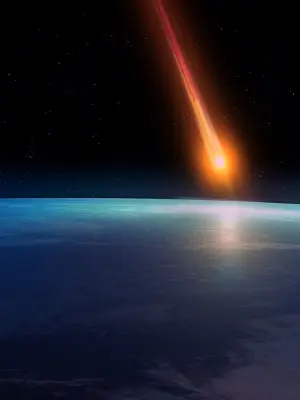
The more the scientist examined the sample, the harder the origin became to explain. Saturn’s rings are made of chunks of ice, and comets are often bodies of ice surrounded by clouds of gas…
Perhaps the piece of ice that fell at Roger’s feet came from the depths of outer space.