
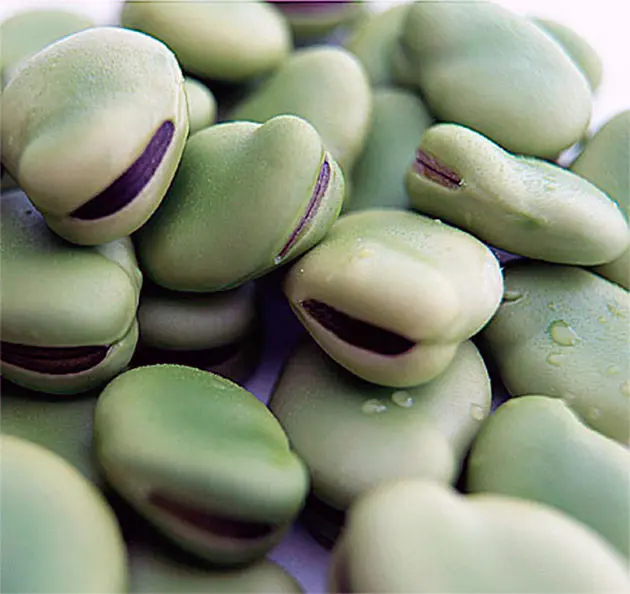
People have cultivated beans since ancient times, and their use was especially prominent in the 18th century in Germany, France, and Sweden. Beans were also popular among Russian peasants. Then the crop fell out of favor for a time, and today it’s rarely grown—despite deserving better. Here’s why.
Beans are delicious when fresh—you eat the immature seeds—but they are primarily grown for their dry seeds.
Russian Black Beans (in the ripe phase)
When the pods develop a parchment layer, they are smooth and slightly netted; if the parchment is thin or missing, the pods become wrinkled. In the first case the pods can crack open. Young pods are green; mature pods are dark brown. Depending on the variety, pod length ranges from 7 to 21 cm and typically contains 3 to 4 seeds, though some varieties hold up to 7. Young pods are fleshy, green, and soft; mature pods grow coarse, leathery, and hard. Seeds vary in size and color.
Long-Forgotten Beans
Use these seeds in both first and second courses. They are rich in vitamins, protein, fats, and fiber—so they offer plenty of nutritional benefits. In terms of protein, vegetable beans surpass green peas, and in calories they exceed potatoes by about 3 to 3.5 times.
What Kind of Plant Is This?
Beans belong to the legume family. This annual plant has a taproot that can reach 100 to 120 cm deep. The stem is straight, four-sided, hollow, and slightly branched at the base, with plants ranging from 20 to 125 cm tall. The leaflets are large, lance-shaped, fleshy, and bluish-green, without serrations.
The inflorescence is a raceme with 4 to 12 flowers. Each flower is 2.5 to 3.5 cm long and is usually white with a black spot on the wings; some varieties have purely white flowers. A flower opens and wilts within two days. The flowers open in the afternoon.
The fruit is a pod. A raceme can carry 1 to 2, and rarely 3 to 4, pods.
Beans in the Milk-Ripeness Phase
A common gray-beige color is widespread, while vegetable varieties can be green or even white and not darken during processing. Near the northern limit of cultivation, dark purple seeds are common.
Vegetable beans begin flowering from the lower nodes; the position of the first flowering node depends on the variety’s earliness—the earlier the variety, the lower the node. Lower nodes produce more flowers than higher ones. Because beans are prone to cross-pollination, maintain spatial isolation when growing two or more varieties; limited garden space often forces gardeners to stick with a single variety. Bean seed can be stored for 10 to 12 years. Pollination is carried out by honeybees and bumblebees.
Of all vegetable legumes, garden beans are among the least demanding in terms of heat. These plants tolerate cold, prefer moisture, and do well in long days. Seeds begin to germinate at 3 to 4°C, and seedlings and mature plants can withstand frosts down to −4°C, growing well at moderate temperatures between 17 and 20°C. The best temperature for seed germination is 19 to 20°C, at which sprouts appear on the 7th day. The optimal air temperature during fruit set and ripening is 15 to 20°C.
Different varieties have varying frost tolerance. For example, Russian Black Beans are less susceptible to frost than Windsor White and Green Beans. As long-day plants, beans flower and fruit much more slowly under short-day conditions.
Beans are particularly sensitive to moisture from germination through flowering; they give the highest yields when sufficient rainfall occurs during this period. They are vulnerable to dry air, making them unsuitable for arid regions.
Time from sowing to germination is typically 10 to 12 days, though cold, wet springs can lengthen this period. Beans are harvested with their foliage; when tied into sheaves, they cure well in a barn or attic. Hang the sheaves upside down by their roots.
Varieties
Which vegetable bean varieties do we grow? Common choices include the Russian Black Beans mentioned above and Windsor White and Green Beans, which are common in Belarus and Ukraine.
Russian Black Beans. This variety was selected from a local sample.
Plants reach 50 to 60 cm, with branching stems that produce 1 to 2, sometimes 3 branches. Flowers are white with purple streaks on the sail and dark spots on the wings. A plant can bear 6 to 16 pods. The first pod forms at the 5th to 6th node. Pods are slightly curved and wrinkled, measuring 7 to 8 cm long and 1.5 to 2 cm wide. Pods do not crack open at maturity. Seeds are elongated-oval, dark purple; 1000-seed weight ranges from 1100 to 1300 g.
This variety is mid-early, requiring 72 to 80 days from germination to seed maturity, with 22 to 27 days from germination to flowering and 60 to 65 days to technical ripeness. Yield is about 50 kg of seed per hectare. Beans can also help reduce wireworm populations.
Belarusian Beans. This variety originated from a Belarusian sample and was improved by progeny testing and mass selection.
Plants grow 60 to 100 cm tall with weak branching. Flowers are white with brown streaks on the sail and dark spots on the wings. The first pod forms at the 6th to 7th node. Pods are straight, 8 to 11 cm long and about 2 cm wide. Plants produce 6 to 10 pods each. The surface is smooth and netted, with a dark green color at removable ripeness. Pods crack open at maturity and contain 3 to 4 seeds. Seeds are elongated-oval, light brown becoming brown with time; 1000-seed weight ranges from 1050 to 1200 g.
This variety is mid-late, taking 90 to 110 days from germination to seed maturity and 23 to 28 days to flowering. Yield is similar to the Russian Black variety. It is recommended for cultivation in Belarus and Latvia.
How to Cultivate Beans?
The best soils for beans are heavy clay soils well-fertilized with manure. Beans also grow on lighter, moist soils but perform poorly in acidic ground. Peaty and marshy soils can work if you apply copper-containing fertilizers; without copper, plants produce many stems but few seeds.
Vegetable beans follow cabbage, beets, and turnips well in crop rotation. Beans themselves make a good predecessor for many crops. Dig the soil to at least 25 cm in the fall. In spring, apply organic and mineral fertilizers: 0.5 to 1 bucket of manure, 30 to 50 g of superphosphate, and 10 to 20 g of potassium chloride per square meter.
While preparing soil with rakes, you can also add 30 g of garden fertilizer mix and two cups of ash per square meter.
Before sowing, sort seeds and remove any damaged by pests or disease. Warm seeds for 3 hours at 40°C (on a radiator) or for 5 minutes in hot water at 50°C, then cool them quickly in cold water. Soak seeds in room-temperature water for 4 to 5 hours before warming. Warming the seeds significantly improves germination.
The best time to sow beans is mid-May when the soil is still moist, because seedlings need plenty of moisture for initial growth. Sow in rows spaced 50 to 60 cm apart, with seeds 10 to 15 cm apart within the row. Plant 20 to 30 viable seeds per square meter at a depth of 6 to 8 cm. Beans are often sown alongside potatoes—either under the spade or placed in holes during potato planting (one to two seeds to the side)—and in rows with cucumbers. This intercropping can boost yields.
Keep crops loose and free of weeds. Cultivate between rows with hoes several times to a depth of 8 to 13 cm, stopping when plants reach 50 to 60 cm tall. During the second and third loosenings, hill the plants to strengthen their root systems and increase wind resistance. At the same time, apply mineral fertilizers.
Harvest timing depends on how you plan to use the crop. If you want to eat the whole pods, pick when the pods are juicy and the seeds reach about 1 cm in size. If you harvest seeds for fresh eating, pick when seeds are fully sized for that variety in the milk-ripeness stage.
Collect the harvest in 3 to 4 rounds at 8 to 10 day intervals. Hand-pick the pods carefully to avoid damaging plants. Average yields of immature pods are about 1 kg per square meter, while immature seeds yield about 0.4 kg per square meter.
For seed harvesting, wait until the lower pods turn black. Pull out the stems and cure them in small bundles. Thresh by hand to extract the seeds from the pods. From one plant, you can collect about 30 to 50 g of seeds.
Pest and Disease Control
Vegetable beans are often damaged by black aphids. Control them by spraying with a 2–4% emulsion of green soap (200–400 g per 10 liters of water) when pests appear. The most dangerous pest for beans is the root weevil: adults eat the leaves of young seedlings while larvae feed on the root tubers. Seedlings are especially vulnerable during dry weather.
Protect sown seeds and young seedlings from rooks.
Diseases
A common disease affecting beans is blackleg: the root neck turns brown, thins, and sometimes develops a dirty-white mycelial coating. Infected plants wilt, droop, and can be pulled out easily. The fungus survives in the soil.
Rust affects leaves and stems. Brown spots appear on the underside of leaves and on stems, later becoming dark brown pustules.
Brown spot shows as brown lesions on the leaves, with pycnidia forming in the centers. Leaves dry and fall off; in severe cases the disease spreads to pods and seeds and cuts yield significantly.
Ascochyta produces dirty yellow to brown spots on leaves and stems, with pale centers surrounded by a dark red halo. Spots on pods are round, almost black, and sunken. Infection of young pods is the most dangerous because seeds inside them fail to develop.
Fusarium is also very dangerous. The fungus moves up the stem from the root neck and attacks the plant’s vascular system. Young plants can die completely; older plants show wilting leaves and a pink or reddish coating on vessels. Leaves wilt and dry quickly. Fusarium appears in warm, humid weather and particularly affects large-seeded varieties.
Control Measures. Follow crop rotation (return to the same plot after 5–6 years), practice proper soil treatment, sow healthy seeds, destroy post-harvest residues, care for seedlings and young plants, hill them, and fertilize with mineral fertilizers. These agronomic practices are the main defenses against bean diseases.
Typically, beans are consumed fresh. Green beans are best eaten the day you harvest them. They can be stored fresh, but only for a short time and only in the refrigerator in small packages.
