
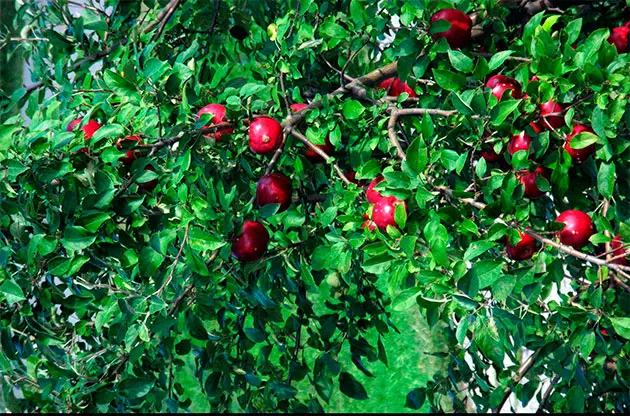
For centuries people have relied on the wild plants around them. Wild species often stand out for one big reason: they’re tougher in harsh conditions. Even now, with thousands of cultivated varieties available, wild flora still supplies the raw material for new crops. About 15,000 cultivated apple varieties trace their ancestry to wild species. The genus Malus includes roughly 50 wild apple species that thrive across the temperate, warm-temperate, and subtropical zones of the Northern Hemisphere. In our country, 17 wild apple species can be found. The main progenitors of domestic varieties are the forest apple, the eastern apple, the Siberian apple, and the Sivers apple. In the natural apple forests of the Voronezh and Kursk regions, the forest apple and early apple are prevalent; in the mountains of Central Asia—specifically the Tian Shan and Pamir ranges—you can find the Kyrgyz apple and Sivers apple; and in Siberia, particularly in Buryatia, the Chita region, Khabarovsk Krai, and the Amur region, the Siberian apple thrives.
Beyond their culinary uses (fresh, dried, cooked, preserved, and in jams, jellies, pastes, cider, and wine), wild apple species play a big role in breeding programs aimed at drought-resistant, winter-hardy, and disease-resistant varieties. For example, I.V. Michurin used the Nedzvedsky apple to develop red-colored varieties such as Yakhontovoe, Red Standard, and Belyfler Red; the resilient, winter-hardy leaf apple contributed to varieties like Belyfler Kytayka, Kytayka Zolotaya, Kandil Kytayka, and Pepin Shafran.
Wild apples are also highly decorative. They bloom and fruit abundantly each year and display a wide range of flower and fruit colors. In spring they can be spectacular—trees covered in deep purple or dark pink blossoms. Examples include Nedzvedsky, Purple, and Blood-red apples. These species often have purple leaves and waxy, violet-red fruits. The Nedzvedsky apple, found in the Tian Shan mountains, needs protection and is listed in the Red Book of endangered species.
One of the most ornamental apples is the Remarkable apple from China, known for its dark pink buds and large pale pink flowers measuring 4–5 cm across. This variety is among the longest-blooming apples, flowering for about a month. Among the tall species, the Manchurian apple stands out, reaching heights of up to 30 meters with large white flowers.
In addition to entire-leaf apples, some have lobed leaves that resemble those of maples, rowans, and hawthorns. One such species is the Torin-go-like apple, which grows in the mountains of southwest China at altitudes of 3,000 to 3,600 meters. It is characterized by its five-lobed leaves and abundant flowering and fruiting.
In Moscow, wild apples bloom from May to June. The display starts with European species, followed by Siberian, Far Eastern, and East Asian species, and finally North American apples. By combining red-leaved and green-leaved varieties and selecting them by flowering time, gardeners can create picturesque groupings. The most decorative apples work well planted individually or in small groups. Tall species (like Manchurian and Tsumi) are suitable for lining roads and creating avenues in community gardens or rural areas.
Because wild apples have robust, highly branched root systems, they can be planted on slopes to prevent erosion. Apple trees are also excellent honey producers: one hectare of apple orchards can yield about 20 kg of honey.
Most wild apples reproduce from seed; however, some species (like the Kyrgyz apple and Sivers apple) tend to propagate vegetatively through branch rooting. Cultivated varieties are grafted onto wild species, using forest, leaf, or Siberian apples as rootstocks.
Wild species show exceptional polymorphism, especially those growing in mountainous conditions. The Central Asian Kyrgyz apple, for example, varies widely in fruit taste, size, and color. Researcher A.A. Fedorov identified around 100 primary forms of this apple.
Another characteristic of wild apples is their tolerance of pruning and shaping, which makes it possible to train them into various forms. While cultivated varieties usually live 30 to 100 years depending on the variety, wild apples can live 300 years or more.
Even this brief overview shows how immense a treasure our wild apple forests are and what a unique breeding resource they offer. We have a duty to protect these invaluable natural treasures.