
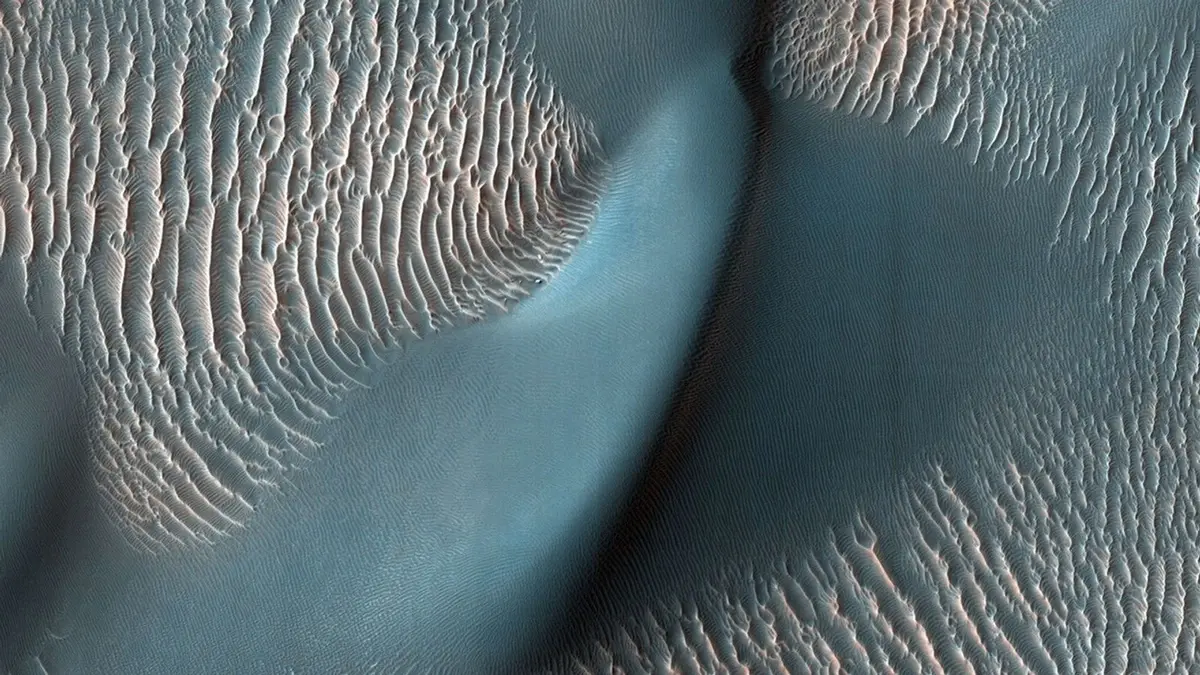
 This milestone marks the 100,000th image of . The NASA Mars Reconnaissance Orbiter (MRO) captured this stunning shot using its high-resolution HiRISE camera, showcasing an area of moving sand dunes.
In just a few months, the MRO will begin its 20th year of observing the . On average, the satellite takes about 5,000 images each year, which breaks down to 417 per month and roughly 14 each day. It started its photographic journey in March 2006, according to the National Aeronautics and Space Administration (NASA).
What else did NASA researchers reveal?
The new, landmark photo features the region of Syrtis Major, known for its table mountains (flat-topped mountains with steep slopes), craters, and dunes. This vast volcanic plateau is located southeast of Jezero Crater, the site of an ancient lake where the Perseverance is searching for signs of life.
The MRO has frequently observed this area and has found evidence that the local sand dunes are slowly shifting across the surface of the Red Planet.
“The HiRISE camera has not only revealed how different the Martian surface is from Earth’s, but it has also shown us how this surface changes over time. We’ve observed how dunes move under the influence of the wind and how avalanches race down steep slopes,” said Leslie Tampari, the deputy project scientist for MRO at NASA’s Jet Propulsion Laboratory.
Studying how the Red Planet evolves over time will help researchers unravel the mysteries of the forces that govern it and determine whether it was once a lush, water-rich world similar to Earth.
Occasionally, the MRO takes a break from its primary Martian mission to gaze into the cosmos. In October, the spacecraft captured an image of the interstellar comet 3I/ATLAS as it passed about 30 million kilometers away. This is significantly closer than the comet’s nearest approach to Earth on December 19, as reported by Live Science.
Overall, the MRO was not designed to observe small, fast-moving objects at such great distances. However, it successfully confirmed that 3I/ATLAS exhibits the characteristic features of a natural comet, including a small nucleus surrounded by a coma—a cloud of gas and dust.
Photo: NASA
