
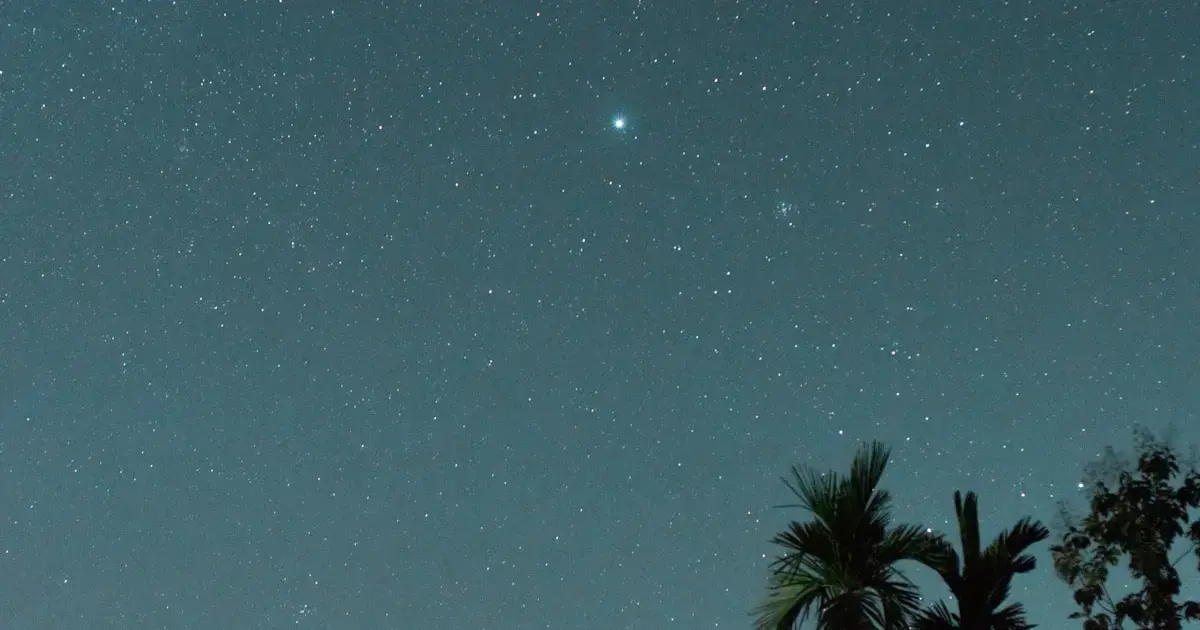
 If you look up at a clear sky during dawn or sunset, you can easily spot Venus. The second planet from the Sun and the sixth largest in our solar system appears as the brightest point, shining consistently.
Venus is the second brightest object in the night sky after the Moon. “The planet is about 100 times brighter than a first-magnitude star,” explained Anthony Mallama, a researcher at the International Astronomical Union’s Center for the Protection of Dark and Quiet Skies, to Live Science. First-magnitude stars are the brightest in the night sky. For instance, one of them, Sirius, has a brightness of -1.47, while Venus shines at -4.14 (on a scale where dimmer objects have a higher magnitude).
But what makes Venus so bright?
Research has shown that several factors contribute to Venus’s brightness. One of them is the planet’s high albedo, which is the amount of light reflected from its surface. According to Sanjay Limaye, a leading scientist at the Space Science and Engineering Center at the University of Wisconsin (USA), Venus has an albedo of 0.76. This means it reflects about 76 percent of the sunlight it receives. For comparison, a perfect mirror reflects 100 percent of light, Earth reflects about 30%, and the Moon, which has a low albedo, reflects only 7%.
Venus’s high albedo is due to its dense cloud cover. These cloud layers extend from 48 to 70 kilometers above its surface. Data from space missions in the 1970s and 1980s indicate that these layers are mostly composed of sulfuric acid droplets. According to Limaye, these droplets are very small—mostly the size of bacteria. They are also extremely effective at scattering sunlight.
However, Venus is not the brightest object in the solar system. Saturn’s icy moon Enceladus has a high albedo of about 0.8. Yet, from , it appears significantly dimmer than Venus. The reason is that it is located much farther from the Sun. While Venus is 108 million kilometers away from our star, Enceladus is at least 13 times farther. Consequently, Venus receives 176 times more light than Enceladus, giving it a substantial advantage.
Distance from Earth
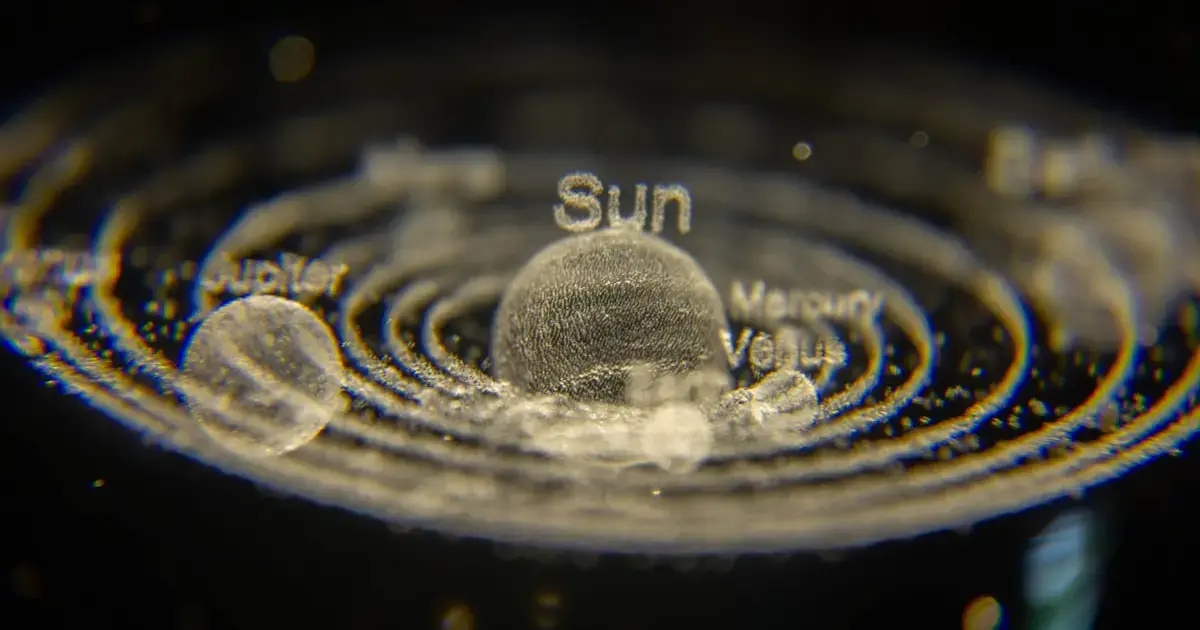
The proximity to Earth also affects Venus’s brightness. The average distance between Venus and Earth is 170 million kilometers. Interestingly, sometimes the closest planet to Earth is Mercury, which, at times, is at an average distance of 155.5 million kilometers. However, Venus’s larger size makes it appear brighter.
Nevertheless, the distance of Venus from Earth, and thus its apparent brightness, is not constant. At its closest (about 38 million kilometers), during what is known as inferior conjunction, Venus can appear quite dim. This has been confirmed by observations from the National Astronomical Observatory of Japan.
Venus shines brightest when only a crescent of its sunlit surface is visible. This phase, known as the point of greatest brightness, typically occurs about a month before and after inferior conjunction. According to a study co-authored by Mallama, during this phase, sulfuric acid droplets in Venus’s atmosphere scatter sunlight toward Earth. “This phenomenon is called a glory, and it belongs to the same family of optical effects as rainbows,” the scientist explained.
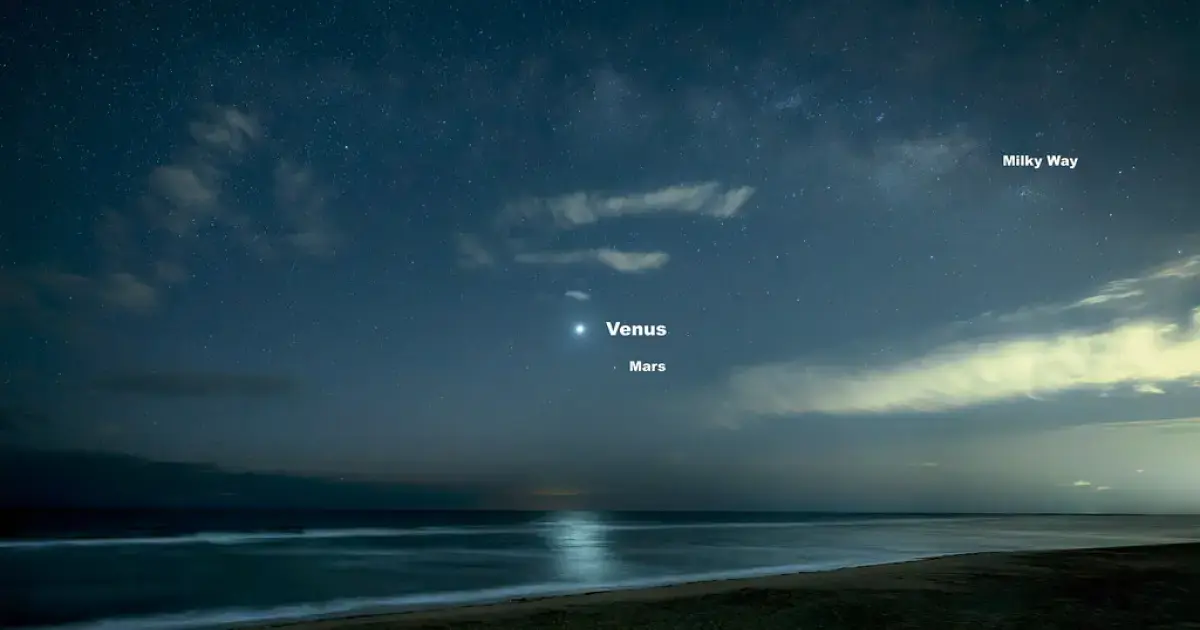
Astronomers have also found that changes in Venus’s albedo, its distance from Earth and the Sun, as well as its phases, cause fluctuations in the planet’s stellar magnitude from -4.92 to -2.98. However, this is enough for people to enjoy the stunning glow of Venus for most of the year, even from urban areas on our planet.
Photo: Unsplash