
 Both instruments are conducting observations for the National Aeronautics and Space Administration (NASA).
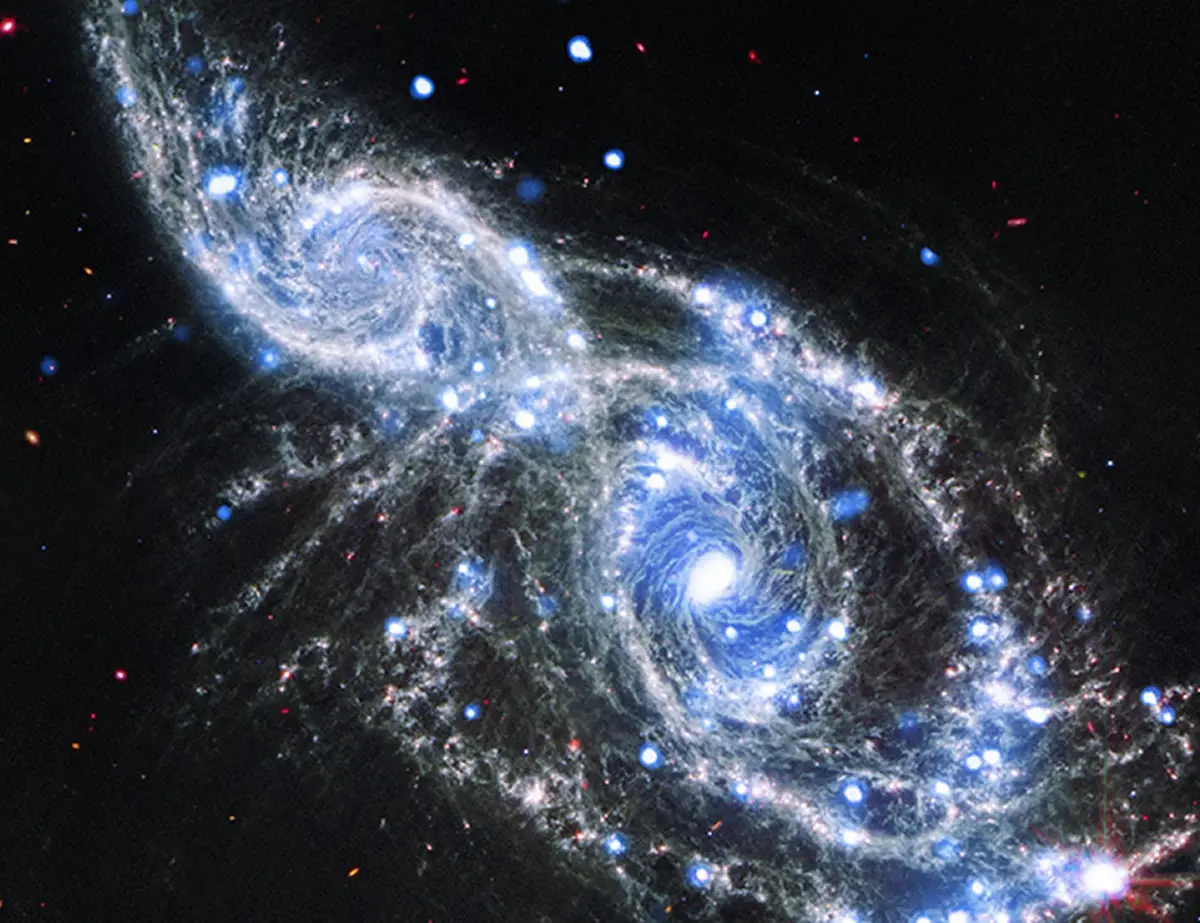
The photograph, informally dubbed the “web of chaos” by astronomers, combines data from the James Webb Space Telescope (JWST) and the Chandra X-ray Observatory. The image showcases two galaxies in the midst of a collision, with their spiral arms intertwining and bending toward the cores of their neighboring , as reported by Live Science.
This stunning dual portrait of the galaxies NGC 2207 (bottom right) and IC 2163 (top left), which have found themselves in a “cosmic accident,” was created using various types of light. The image was particularly made possible through the combination of infrared light from the James Webb Telescope and X-ray light from Chandra. Scientists noted that the photograph accurately conveys the colors and shapes of these gravitationally bound massive systems, each rotating around its center of mass.
What else is known about this image?
The galaxies NGC 2207 and IC 2163 are in a state of slow gravitational merging, fortuitously observed from the Solar System head-on. The larger galaxy, NGC 2207, dominates the field of view, while the smaller IC 2163 overlaps its outer regions. The gravitational pull of each galaxy distorts the spiral arms of its neighbor, stretching streams of stars and gas and compressing gas and dust in a way that may trigger the formation of new stars. The result is a complex and enchanting web of chaos.
NASA reminded us that one of the primary goals of the JWST is to provide scientists with a clear understanding of the centers of merging galaxies, thereby aiding in the development of a new generation of models that describe the interactions and mergers of galaxies. The galaxies NGC 2207 and IC 2163 are perfect candidates for this.
In the image, JWST data in the mid-infrared range is represented in white, gray, and red, showcasing primarily dust and cooler material in the cores of the galaxies and their spiral arms. X-ray data from Chandra is shown in blue, highlighting high-energy regions of the two galaxies—binary stars, remnants of dead stars, and areas where supernovae have occurred.
This multi-layered photo of NGC 2207 and IC 2163 is one of four complex images recently obtained using the Chandra telescope and published simultaneously. The other three images depict the star-forming region NGC 6334, known for its arcs of gas and dust; the supernova remnant G272.2-0.3, where hot X-ray gas fills an expanding shell; and the star system R Aquarii, where a white dwarf is siphoning material from a red giant.